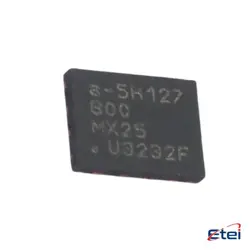
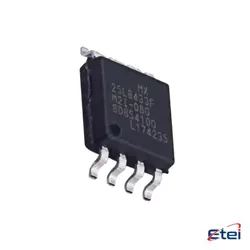
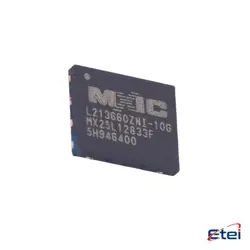
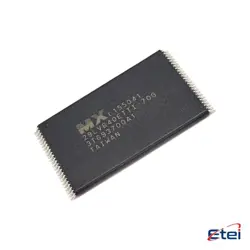
圖片僅供參考
MX25L25673GMI-10G
+物料清單IC FLASH 256MBIT SPI 16SOP
-
製造商旺宏
-
製造商部分 #MX25L25673GMI-10G
-
有存貨6817
365 天品質保證
7*24 小時服務保證
90-日售後保障
正品保證
規格
| 屬性 | 價值 |
| Series | MXSMIO™ |
| Part Status | Not For New Designs |
| Base Product Number | MX25L25673 |
| Digi Key Programmable | Not Verified |
| Memory Type | Non-Volatile |
| Memory Format | FLASH |
| Technology | FLASH - NOR |
| Memory Size | 256Mbit |
| Memory Organization | 32M x 8 |
| Memory Interface | SPI |
| Clock Frequency | 120 MHz |
| Write Cycle Time - Word, Page | 30µs, 750µs |
| Voltage - Supply | 2.7V ~ 3.6V |
| Operating Temperature | -40°C ~ 85°C (TA) |
| Mounting Type | Surface Mount |
| Package / Case | 16-SOIC (0.295", 7.50mm Width) |
| Supplier Device Package | 16-SOP |
| Packaging | Tube |
概述
Description
Equivalent
- Winbond W25Q256JV (W25Q256FV) — 3V, up to 104 MHz
- GigaDevice GD25Q256D — 3V, up to 104/133 MHz
- ISSI IS25LP256D — 3V, SPI
- Cypress/Spansion S25FL256S — 3V, SPI
- Microchip/Atmel AT25SF256D — 3V, SPI
Note: electrical/timing details vary; verify voltage, timing, and command compatibility for your design.
Features
- Density: 256 Mbit (32 MB) serial flash
- Interfaces: SPI with Dual I/O and Quad I/O (QPI) modes
- Addressing: 4-byte addressing to access full capacity
- Speed: up to 104 MHz in standard SPI; high-speed via QPI modes
- Organization: 256‑byte pages; 4 KB sectors; 64 KB and 32 KB blocks
- Operations: page program (up to 256 bytes); sector/block erase
- Endurance/retention: ~100k P/E cycles; data retention ~20 years
- Voltage: 2.7–3.6 V
- Temperature: industrial grade typically −40 to 85 °C
- Power modes: deep power-down and fast wake
- Security/ID: write/read protection features, WP#, block protection, status register, Unique ID
- Reliability: JEDEC-standard protections and reliability features
- Applications: firmware/BIOS storage, code shadowing, data storage
- Packaging: available in compact serial flash packages (e.g., SOIC-8/WSON-8)
Note: exact timing and package options may vary by variant; refer to the datasheet for precise specs.
Pinout
- Function: 256‑Mbit Serial NOR Flash memory with SPI interface (SCK, SI, SO, CS) plus WP# and HOLD# control pins, and VCC/GND for nonvolatile storage (firmware/data).
Manufacturer
What kind of company: Macronix is a Taiwanese semiconductor company that designs and manufactures non-volatile memory products (notably NOR flash and related memories). It is an integrated device manufacturer (IDM) with its own fabrication facilities, specializing in flash memory and other non-volatile memory technologies.
Application
- Embedded MCUs/SoCs boot and program memory
- Firmware storage and OTA updates in consumer electronics (set‑top boxes, TVs, printers, wearables)
- Automotive ECUs, instrument clusters, gateways (rugged, wide‑temp flash)
- Networking/telecom gear (routers, switches, modems) for code/config storage
- Industrial control and medical devices needing rugged non‑volatile storage
- Data logging buffers in space‑constrained systems
Package
Frequently Asked Questions
Q: What is the maximum clock frequency for SPI communication with this MX25L25673GMI-10G?
A: The device supports a maximum SPI clock frequency of 120 MHz, enabling high-speed read and write operations.
Q: What is the memory organization of this Macronix NOR Flash?
A: It has a memory size of 256 Mbit organized as 32M x 8 bits, suitable for code shadowing or data storage.
Q: What is the write cycle time for a page and a word?
A: Page write time is 750 µs, and word write time is 30 µs, ensuring efficient programming for embedded applications.
Q: What are the operating voltage and temperature ranges?
A: It operates from 2.7V to 3.6V and supports a temperature range of -40°C to +85°C, making it suitable for industrial environments.
Q: What is the package type for this FLASH memory?
A: It comes in a 16-SOIC (7.50mm width) package with a supplier device package of 16-SOP, supplied in tube packaging.
Q: Is this memory component recommended for new designs?
A: No, the part status is "Not For New Designs," so it is intended for existing projects or maintenance rather than new product development.